
目次
――一冊の写真集と一枚の新聞から見えてきたもの
生前整理の現場で、古い一冊の写真集が見つかりました。
表紙に記されていたのは、
『皇室御寫眞集』
昭和26年(1951年)に発行された一冊です。
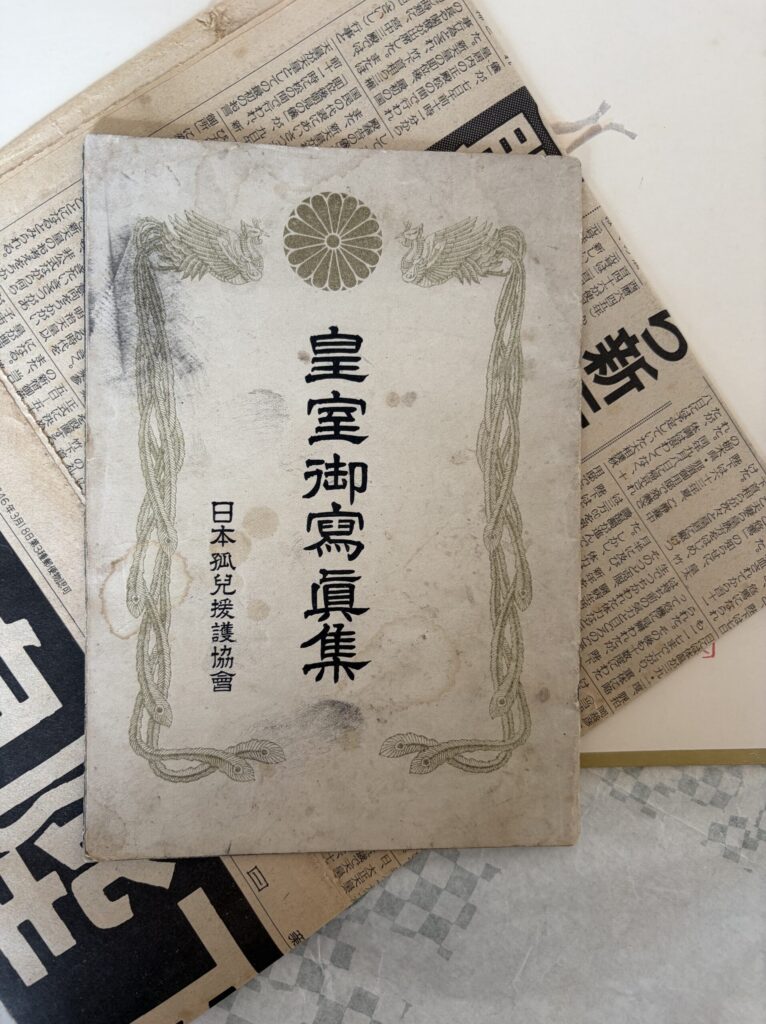
ページを開くと、皇居二重橋、天皇・皇后、皇太子、天皇御一家、雛祭り、そして孤児を慰問する天皇夫妻の姿など、戦後まもない時代の皇室を写した写真が収められていました。
奥付に残されていた発行情報
この写真集の奥付には、発行当時の情報が具体的に記されています。
頒布価は60円。
編集兼発行人は美平晴道、発行所は日本孤児援護協会。印刷所として東京グラビャ印刷株式会社の名が記され、札幌・仙台・金沢・名古屋・大阪・岡山・福岡には全国支部が置かれていたことも確認できます。
また、奥付には「不複製許」と記されています。
こうした記載からも、この小さな写真集が、個人的に作られた冊子ではなく、戦後の日本孤児援護協会によって組織的に発行・頒布されていた資料であることがうかがえます。
そして今回見つかった現物は、奥付を含む資料そのものから、昭和26年(1951年)発行であることを確認しています。
全16ページほどの小さな写真集です。
しかし、今回、特に印象に残ったのは、写真集そのものだけではありませんでした。
その残され方です。
写真集とともに残されていたのは、昭和64年1月7日付の新聞でした。
昭和天皇の崩御を伝えた、まさに「昭和最後の日」の新聞です。
その新聞は、無造作に置かれていたわけではありません。
丁寧に畳まれ、その中に写真集が包まれていました。
昭和という時代が始まってから約60年。
その終わりを伝える新聞の中に、昭和26年、戦後6年の日本で発行された写真集が残されていたのです。
昭和26年という時代
1951年。
第二次世界大戦の終結から、まだ6年しか経っていません。
戦後の日本は、まだ復興の途上にありました。
その時代に発行された『皇室御寫眞集』には、当時の皇室の姿だけではなく、戦後社会の一側面も刻まれています。
なかでも目を引くのが、
「孤児を慰問する天皇夫妻」
の写真です。
戦争によって多くのものを失った社会の中で、皇室がどのように写され、また当時の人々に何を伝えようとしていたのか。
一冊の小さな写真集から、戦後日本の空気を考える手掛かりが残されています。
現在確認できる所蔵例
この『皇室御寫眞集』について、所蔵状況も調べてみました。
国立国会図書館の「島内志剛関係文書目録」には、日本孤児援護協会の『皇室御写真集』が1冊記録されています。
また、九州歴史資料館系の「安高文書」の目録にも、編集兼発行人を美平晴道、発行所を日本孤児援護協会とする『皇室御写真集』が1冊記録されています。
さらに現在の古書市場でも、同じ日本孤児援護協会・美平晴道の『皇室御写真集』の現存個体が確認できます。
したがって、今回の調査から「現存するのは一冊だけ」とすることはできません。
一方で、今回見つかった個体については、昭和26年(1951年)発行であることを現物から確認しています。
戦後6年という時期に発行された一冊が、昭和最後の日を伝える新聞に包まれて、現在まで残されていました。
そのこと自体が、この一冊を記録しておく理由の一つだと思います。
そして、昭和64年1月7日
その写真集を包んでいた新聞の日付は、
昭和64年1月7日。
昭和天皇が崩御された日です。
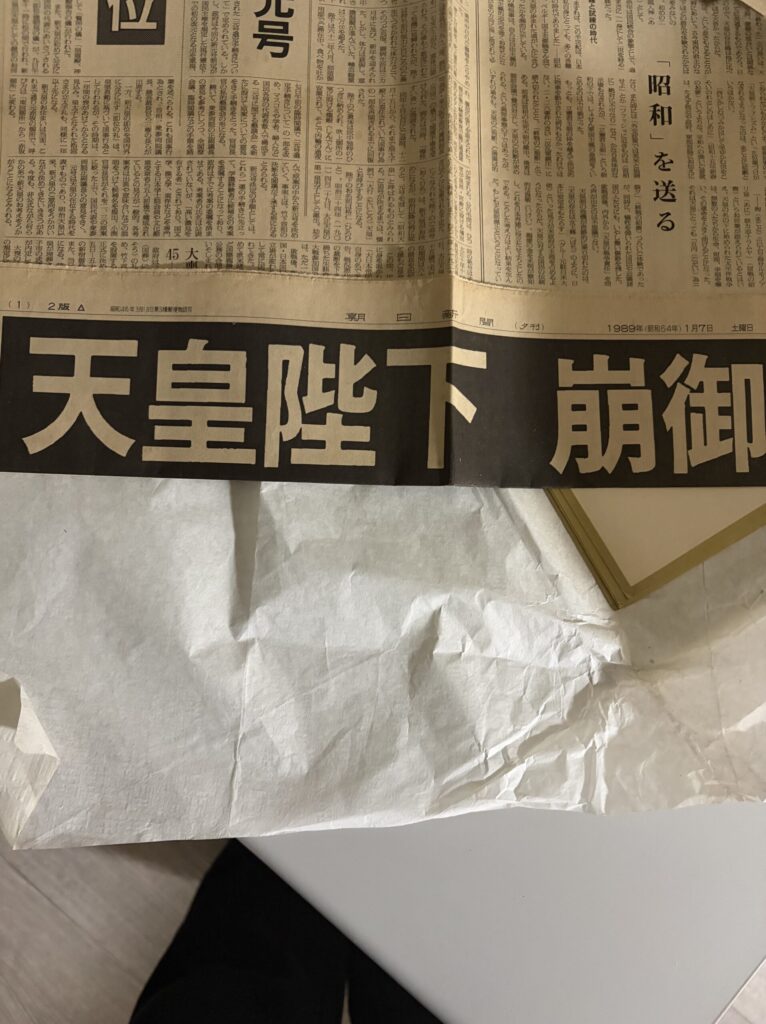
わずか7日間しか存在しなかった「昭和64年」。
その最初の一週間の最後の日に発行された新聞が、昭和26年の写真集を包んでいました。
38年前に発行された写真集と、38年後の新聞。
そこには、昭和という一つの時代の始まりと終わりを考えさせる時間の隔たりがあります。
そして興味深いのは、それらが別々に残っていたのではなく、
一緒に残されていた
ということです。
二つの資料が残した時間
1951年の写真集。
1989年の新聞。
年代だけを見れば、38年の隔たりがあります。
しかし今回の発見では、その二つが一つのまとまりとして残されていました。
丁寧に畳まれた新聞。
その中に包まれていた、38年前の写真集。
この状態そのものもまた、資料を考えるうえで無視できない情報だと思います。
資料は、書かれている文字や写真だけで成り立っているわけではありません。
どのような状態で残されていたのか。
それもまた、その資料が歩んできた時間を考える手掛かりになります。
「昭和」を二つの資料から見る
昭和26年。
戦後の日本が復興へ向かっていた時代。
そして昭和64年。
昭和という時代そのものが終わった日。
その二つの時点を示す資料が、一冊の写真集と一枚の新聞として残されていました。
歴史資料というと、古文書や公文書、著名な人物が残した記録を思い浮かべるかもしれません。
しかし、こうした一冊の写真集や一枚の新聞にも、その時代を生きた人々の時間が残されています。
今回の資料は、まさにそのことを静かに示しているように思います。
何十年後にも残るもの
生前整理では、長い年月を過ごした家から、さまざまなものが現れます。
写真、手紙、新聞、書籍、記録。
一見すると、どれも日常生活の中にあったものです。
けれども、年月が経てば、それらはその時代を知るための手掛かりになります。
今回見つかった『皇室御寫眞集』も、単なる古い写真集として見ることもできます。
しかし、その発行年、掲載された写真、そして昭和64年1月7日の新聞とともに残されていたという事実を重ねて見ると、一冊の本を超えて、一つの時代をまたいで残された資料として見ることができます。
昭和26年から昭和64年へ。
そして昭和から令和へ。
一冊の写真集と一枚の新聞が、長い時間を静かにつないでいました。
おわりに
今回の資料について、私が強く印象に残ったのは、その大きさでも、華やかさでもありません。
残されていた時間そのものです。
1951年に発行された一冊の写真集。
1989年1月7日、昭和の終わりを伝えた新聞。
そして、その新聞に包まれていた写真集。
それらは、誰かが過ごした時間の中で、長い年月を経て現在まで残っていました。
歴史は、いつも大きな出来事だけで残るわけではありません。
一冊の本。
一枚の新聞。
そして、それらが残されていた状態。
そうした小さな断片からも、過ぎ去った時代の姿を知ることができます。
今回の生前整理で出会ったこの二つの資料もまた、昭和という時代の一つの断片として、記録しておきたいと思います。
そして、御依頼者と相談しながら適切な機関に橋渡しをしていきたいと思います。それが歴史の空白を埋める遺品整理士として、日本のあらゆる記憶を保全する事だからです。
The Imperial Photograph Collection and the Last Day of the Showa Era
— What One Photograph Collection and One Newspaper Revealed
During an estate-clearing project, an old photograph collection was discovered.
Its title was:
The Imperial Photograph Collection (皇室御寫眞集)
It was published in 1951 (Showa 26), just six years after the end of World War II.
Opening the book reveals photographs of the Imperial Palace’s Nijubashi Bridge, the Emperor and Empress, the Crown Prince, the Imperial Family, the Hinamatsuri doll festival, and the Emperor and Empress visiting and comforting orphaned children, among other scenes depicting the Imperial Family in the early postwar period.
Publication Information Preserved in the Colophon
The colophon of the photograph collection provides specific information about its publication.
The distribution price was 60 yen.
The editor and publisher was Harumichi Mihira, and the publishing organization was the Japan Orphan Relief Association. The printing was carried out by Tokyo Gravure Printing Co., Ltd. The colophon also indicates that the association had branches across Japan, including Sapporo, Sendai, Kanazawa, Nagoya, Osaka, Okayama, and Fukuoka.
The colophon also bears the statement “Reproduction prohibited” (“不複製許”).
These details suggest that this small photograph collection was not simply a privately produced booklet, but a publication issued and distributed on an organized basis by the Japan Orphan Relief Association in postwar Japan.
The physical copy discovered this time has been confirmed, from the publication information preserved in the book itself, to have been published in 1951 (Showa 26).
It is a small photograph collection of approximately 16 pages.
Yet what left the strongest impression on me was not simply the photograph collection itself.
It was the way it had been preserved.
Together with the photograph collection was a newspaper dated January 7, 1989 (Showa 64).
It was the newspaper reporting the death of Emperor Showa—the very last day of the Showa era.
The newspaper had not simply been left there carelessly.
It had been carefully folded, with the photograph collection wrapped inside it.
Nearly sixty years had passed since the beginning of the Showa era.
Inside a newspaper recording the end of that era, a photograph collection published in 1951—only six years after the end of World War II—had remained.
1951: The Historical Context
Only six years had passed since the end of World War II.
Japan was still in the process of rebuilding after the war.
The Imperial Photograph Collection, published during this period, preserves not only images of the Imperial Family but also an aspect of Japanese postwar society.
One photograph in particular stands out:
“The Emperor and Empress visiting and comforting orphaned children.”
In a society that had lost so much as a result of the war, the photograph provides a glimpse into how the Imperial Family was portrayed and what such images sought to convey to people at the time.
This small photograph collection therefore preserves a means of considering the atmosphere of postwar Japan through visual records from the period.
Confirmed Holding Examples
I also investigated the known holdings of this Imperial Photograph Collection.
The National Diet Library’s catalogue of the Shimauchi Yukitaka Papers records one copy of the Imperial Photograph Collection published by the Japan Orphan Relief Association.
A catalogue of the Ataka Papers, held within the collections associated with the Kyushu Historical Museum, also records one copy of the Imperial Photograph Collection, identifying Harumichi Mihira as editor and publisher and the Japan Orphan Relief Association as the publishing organization.
In addition, surviving copies of the same Imperial Photograph Collection by the Japan Orphan Relief Association and Harumichi Mihira can currently be found on the used-book market.
Therefore, based on the research conducted so far, it would not be accurate to state that only one copy survives.
At the same time, the particular copy discovered in this case has been confirmed from the physical item itself to have been published in 1951 (Showa 26).
A small photograph collection published only six years after the war ended had remained, wrapped inside a newspaper recording the final day of the Showa era.
That fact alone is one reason why I believe this particular copy is worth documenting.
The era known as Showa 64 existed for only seven days.
The newspaper published on the final day of that first week had wrapped the photograph collection from Showa 26 (1951).
A photograph collection published 38 years earlier, and a newspaper from 38 years later.
The 38-year gap between them invites us to consider the beginning and the end of the Showa era as a single span of time.
What is particularly striking, however, is that they were not preserved separately.
They had been preserved together.
The Passage of Time Preserved in Two Documents
A photograph collection from 1951.
A newspaper from 1989.
Chronologically, 38 years separate them.
Yet when they were discovered, the two had remained together as a single grouping.
The newspaper had been carefully folded.
Inside it was the photograph collection from 38 years earlier.
The physical condition in which these materials were found is itself information that should not be overlooked when considering their history.
Historical materials are not defined solely by the words written on them or the photographs they contain.
The condition in which they have survived also matters.
It can provide clues for understanding the journey these materials have taken through time.
Viewing the Showa Era Through Two Documents
Showa 26 (1951).
A period when postwar Japan was still moving toward reconstruction.
And Showa 64 (1989).
The day on which the Showa era itself came to an end.
Records marking these two points in time had remained in the form of a photograph collection and a newspaper.
When we think of historical records, we may imagine old manuscripts, official documents, or records left by prominent figures.
Yet a photograph collection and a newspaper such as these can also preserve traces of the lives and experiences of people who lived through their time.
These materials quietly demonstrate that fact.
What Remains Across the Decades
During an estate-clearing project, many different kinds of materials emerge from homes where people have lived for many years.
Photographs, letters, newspapers, books, and personal records.
At first glance, they may all appear to be ordinary objects from everyday life.
But as the years pass, such objects can become clues for understanding the time in which they existed.
The Imperial Photograph Collection discovered this time could simply be regarded as an old photograph book.
Yet when its publication date, the photographs it contains, and the fact that it had remained together with the newspaper dated January 7, 1989 are considered as a whole, it can be viewed as something more than a single book:
a historical record that survived across an entire era.
From Showa 26 to Showa 64.
And from the Showa era into the Reiwa era.
One photograph collection and one newspaper had quietly connected these different points in time.
Conclusion
What has left the strongest impression on me about these materials is neither their size nor their appearance.
It is the passage of time preserved within them.
A photograph collection published in 1951.
A newspaper dated January 7, 1989, recording the end of the Showa era.
And the photograph collection wrapped inside that newspaper.
These materials had remained within someone’s lived environment, surviving across many decades until they were discovered today.
History does not always survive through major events alone.
A single book.
A single newspaper.
And the condition in which they were preserved.
Even such small fragments can provide a glimpse into a time that has passed.
These two materials, encountered during this estate-clearing project, are also fragments of the Showa era that I believe are worth documenting.
Moving forward, and in consultation with the client, I hope to connect these materials with an appropriate institution so that they can be preserved and made available for future study.
This is part of what I seek to do as an estate-clearance professional dedicated to preserving the historical gaps left within our collective memory—to help safeguard the memories and records of Japan that might otherwise disappear from the historical record.