
目次
- 一枚の小さな証票
- 目録には載せていなかったA4コピー
- 「CLEAR FOR SHIPMENT」は乗船券だった
- 日本軍の資料から、連合国側の復員管理へ
- そして、資料群には「撤退地図」も残されていた
- 答えは、資料の中に残されていた
- 一枚の紙が、80年前の復員につながった
- 歴史の空白を埋める遺品整理
- A Small Document Bearing “CLEAR FOR SHIPMENT”
- An A4 Copy Not Included in the Inventory
- “CLEAR FOR SHIPMENT” Was a Boarding Ticket
- From Japanese Military Records to Allied Repatriation Administration
- A “Withdrawal Map” Also Remained Among the Materials
- The Answer Was Already There in the Materials
- One Small Piece of Paper Led to a Repatriation Journey 80 Years Ago
- Estate Organizing That Fills the Gaps in History
一枚の小さな証票
2026年5月、当社が遺品整理の現場から救出した、故・川合貢氏のビルマ派遣・第121兵站病院関係資料について、これまで確認できた資料を整理し、目録として記録してきました。
その中に、一枚の小さな証票があります。
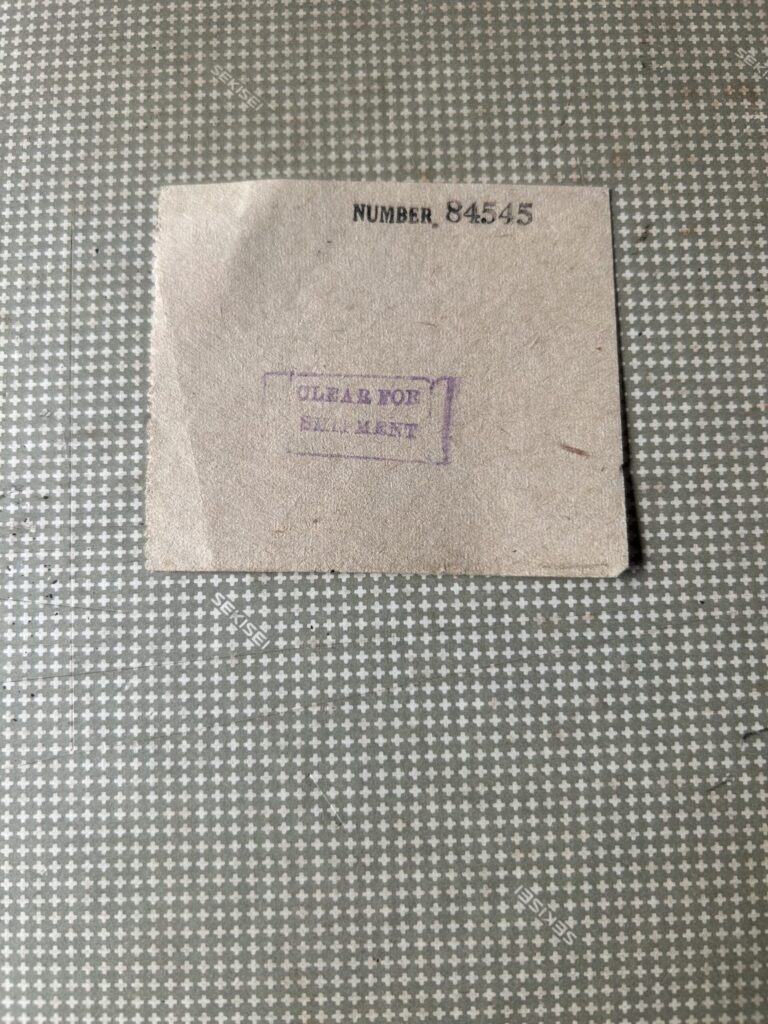
そこには、
NUMBER 84545
そして、
CLEAR FOR SHIPMENT
という文字が確認できます。
これまで、この資料については、その表示から、
「手荷物検閲通過証(CLEAR FOR SHIPMENT)」
として目録に記載していました。
しかし今回、この証票について改めて資料を読み返す中で、その意味を具体的に裏付ける記録が見つかりました。
目録には載せていなかったA4コピー
今回確認したのは、著作権の関係上、川合氏の資料目録には掲載していなかった、A4用紙にコピーされた資料です。
そこには、江連哲夫氏による昭和21年7月の回想が残されていました。
江連氏は、戦後の復員時の出来事を記録しています。
1946年7月。
雨季の中、タイ・バンコク港。
復員者たちはニューライフキャンプを出て、LSTと呼ばれる米軍の輸送艦へ向かいます。
乗船口には英国兵がいました。
そして、その場面で江連氏は、自分が持っていた一枚の証票を見ています。
その記述には、こうあります。
「胸の物入れから取り出して改めて見直す小さな乗船券には、NUBER 72623、そしてCLEA FOR SHIPMNTとゴム印が捺されている。」
この一文でした。
「CLEAR FOR SHIPMENT」は乗船券だった
この記述によって、川合氏の資料に残されていた「CLEAR FOR SHIPMENT」の証票について、重要なことが分かりました。
江連氏の回想に登場する証票には、
NUMBER 72623
そして、
CLEAR FOR SHIPMENT
のゴム印が押されていました。
そして江連氏自身が、それを、
「小さな乗船券」
と記録しています。
一方、川合氏の資料に残されている証票は、
NUMBER 84545
です。
したがって、両者は同一の証票ではありません。
しかし、今回重要なのは番号が一致することではありません。
「CLEAR FOR SHIPMENT」という表示を持つ証票が、復員時の乗船券として使用されていた。
その事実が、別の復員者による当時の回想によって具体的に確認されたことです。
これにより、川合氏の資料目録に掲載していた「CLEAR FOR SHIPMENT」の証票についても、その用途をより具体的に考えることができるようになりました。
日本軍の資料から、連合国側の復員管理へ
さらに興味深いのは、この証票が残された時期です。
1945年の敗戦によって、日本軍の戦争は終わりました。
しかし、兵士たちの戦争がその日に終わったわけではありません。
戦地から撤退し、収容・移動し、復員し、船に乗り、日本へ帰る。
その過程では、それまでの日本軍の記録とは異なる、連合国側による復員・輸送管理の仕組みの中を通過することになります。
江連氏の回想にあるバンコク港、米軍のLST、乗船口の英国兵、そして「CLEAR FOR SHIPMENT」と押された乗船券。
これらは、まさにその境界に存在した記録です。
つまり川合氏の遺品の中に残されていた一枚の小さな証票は、
「日本軍兵士として戦地にいた人物が、敗戦後、連合国側の管理下で復員していく過程」
を示す資料の一つとして見ることができます。
そして、資料群には「撤退地図」も残されていた
今回、もう一つ改めて注目している資料があります。
撤退地図です。
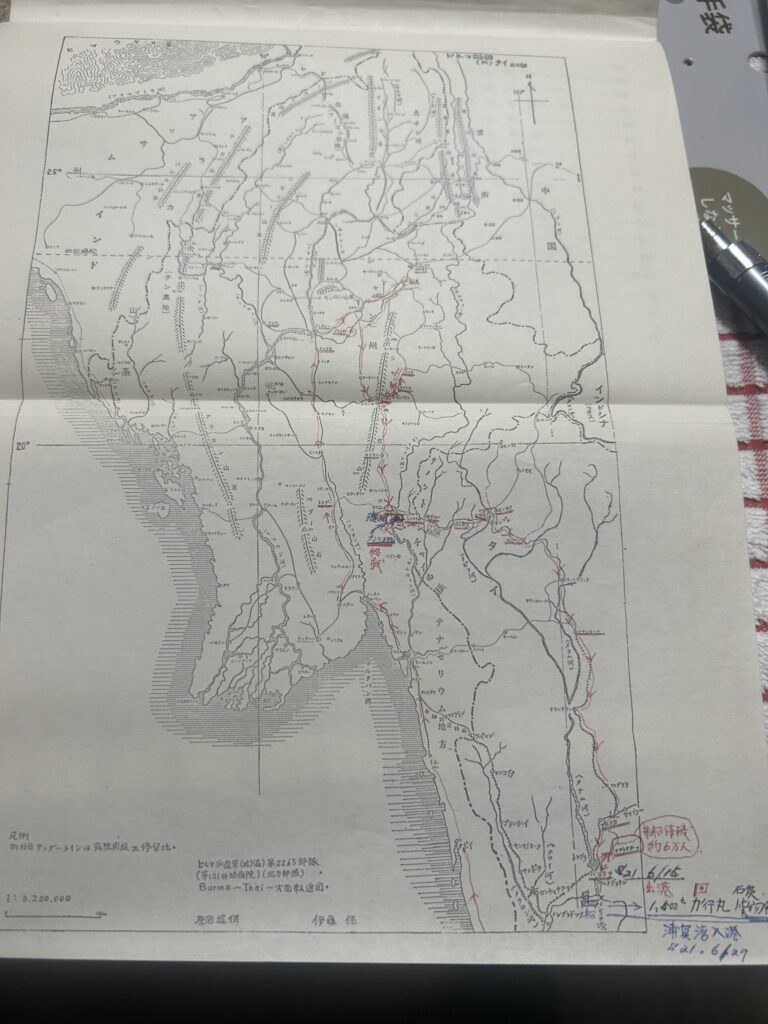
ビルマ戦陣回顧録の初めのページの方に、この地図があります。故人がどう撤退したかを赤ペンでなぞっていました。
しかし、川合氏の資料群には、単なる戦場での記録だけではなく、戦地からの移動や、その後の復員に関係する資料も残されていました。
今回の「CLEAR FOR SHIPMENT」の再確認と合わせて考えると、
戦地での活動
↓
撤退・移動
↓
復員
↓
乗船
↓
帰国
という一連の流れを、複数の資料から追える可能性があります。
一枚の証票だけでは分からなかったことが、別の回想記によって分かる。
さらに地図が加われば、その人物がどこを移動し、どのような過程を経て帰国したのかを、より具体的に考えることができるかもしれません。
答えは、資料の中に残されていた
今回、私が最も重要だと感じたのはここです。
最初から、この証票が乗船券だと分かっていたわけではありません。
「CLEAR FOR SHIPMENT」という文字がある。
何らかの検査や船積みに関係するものだろう。
しかし、それだけでは具体的な用途までは分かりませんでした。
だからこそ、残された資料を調べました。
すると、目録には掲載していなかったA4コピー資料の中に、江連氏の回想がありました。
そして、その回想の中に、
「小さな乗船券」
と、
「CLEAR FOR SHIPMENT」
という二つの言葉が残されていた。
答えは、外部から新しく与えられたものではありません。
救出された資料の中に、すでに手掛かりが残されていたのです。
一枚の紙が、80年前の復員につながった
川合貢氏の資料に残された、
NUMBER 84545
CLEAR FOR SHIPMENT
という一枚の証票。
そこだけを見れば、小さな紙片に過ぎません。
しかし、同じ時代の復員者である江連哲夫氏の回想には、
NUMBER 72623
CLEAR FOR SHIPMENT
と記された「小さな乗船券」が登場します。
この二つの資料を照らし合わせることで、川合氏の資料に残された証票についても、その歴史的な意味がより具体的に見えてきました。
そして、その背景には、
バンコク港。
LST。
英国兵。
復員。
そして、戦争が終わった後も続いていた兵士たちの帰還があります。
江連氏は、その回想の最後に、
「我々の今までの、他国に於ける行動の免罪符なのであろうか。すべてが終わった。」
と記しています。
一枚の乗船券を見つめながら書かれた、この言葉。
それは単なる復員手続きの記録ではなく、戦争を生き残った一人の人間が、戦争の終わりをどのように受け止めたのかを伝える記憶でもあります。
歴史の空白を埋める遺品整理
私は歴史学者ではありません。
遺品整理の現場に立つ者です。
だからこそ、現場で見つかった資料を「古い物」で終わらせず、
これは何なのか。
誰が使ったのか。
なぜここに残っているのか。
他の資料とつながらないか。
と、一つずつ調べていきたいと考えています。
何故なら、発見した責任があり、それを御遺族に正しく伝えたいからです。
何もわからず寄贈するのは、御遺族に対して不誠実だからです。
だから出来る限り調べるのです。
寄贈したあとに、本当の価値がわかり怒り狂う寄贈者もいると思います。
橋渡し役として、知らねばならない。だからこそ、情熱をもって真剣に向き合い、真実を知り、御遺族に伝えたいと考えています。
資料である前に、大事な故人の記憶で、御遺族にとってかけがえのない御遺品だからです。
今回の「CLEAR FOR SHIPMENT」も、最初は意味の分からない小さな証票でした。
しかし、捨てずに残し、資料である御遺品を読み返したことで、その証票がどのような場面で使われたのかを示す記録が見つかりました。
一枚の小さな証票から、80年前の復員の風景が見えてきました。
これもまた、遺品整理の現場から歴史の空白を埋めていく、一つの記録です。
歴史の空白を埋める遺品整理士。
A Small Document Bearing “CLEAR FOR SHIPMENT”
In May 2026, our company rescued a collection of materials related to the late Mitsugu Kawai, a sanitary soldier who was dispatched to Burma and served with the 121st Logistical Hospital, during an estate cleanout.
Since then, we have been organizing and documenting the materials that we have been able to identify, compiling them into an archival inventory.
Among them was a small document bearing the words “CLEAR FOR SHIPMENT.”
There, the following words can be clearly identified:
NUMBER 84545
and
CLEAR FOR SHIPMENT
Until now, based on this wording, I had catalogued the item as:
“Baggage Inspection Clearance (CLEAR FOR SHIPMENT)”
However, while reviewing the materials again in order to better understand this document, I found a record that provides concrete evidence of its meaning and use.
An A4 Copy Not Included in the Inventory
What I examined this time was a document copied onto an A4 sheet which, due to copyright considerations, had not been included in Mr. Kawai’s archival inventory.
It contains a recollection written by Tetsuo Ezure in July 1946 (Showa 21).
Mr. Ezure recorded events from his repatriation after the war.
In July 1946, during the rainy season, at the port of Bangkok, Thailand, repatriated soldiers left New Life Camp and headed toward an American military transport vessel known as an LST.
A British soldier was stationed at the boarding entrance.
It was at this moment that Mr. Ezure looked again at a small document he was carrying.
His recollection states:
“Taking the small boarding ticket from the pocket of my chest, I looked at it again. It bore the number 72623, and a rubber stamp reading CLEAR FOR SHIPMENT.”
This was the crucial sentence.
“CLEAR FOR SHIPMENT” Was a Boarding Ticket
This description revealed an important fact concerning the “CLEAR FOR SHIPMENT” document preserved among Mr. Kawai’s materials.
The document described in Mr. Ezure’s recollection bore:
NUMBER 72623
and
CLEAR FOR SHIPMENT
as a rubber stamp.
And Mr. Ezure himself described it as:
“a small boarding ticket.”
The document preserved among Mr. Kawai’s materials, on the other hand, bears:
NUMBER 84545
Therefore, the two documents are not the same physical item.
However, the important point is not whether their numbers match.
It is that:
a document bearing the words “CLEAR FOR SHIPMENT” was used as a boarding ticket during the repatriation of Japanese soldiers.
This fact is specifically documented in the contemporary recollection of another repatriated soldier.
This allows us to consider more concretely the function of the “CLEAR FOR SHIPMENT” document recorded in Mr. Kawai’s archival inventory.
From Japanese Military Records to Allied Repatriation Administration
Another particularly interesting aspect is the period in which this document was used.
With Japan’s defeat in 1945, the Japanese military’s war came to an end.
But for the soldiers themselves, the war did not necessarily end on that day.
They still had to withdraw from their areas of deployment, pass through detention and transportation procedures, board ships, and eventually return to Japan.
In this process, they passed through repatriation and transportation procedures administered under Allied control, distinct from the record-keeping systems of the former Japanese military.
The Bangkok port described in Mr. Ezure’s recollection, the American LST, the British soldier at the boarding entrance, and the boarding ticket stamped “CLEAR FOR SHIPMENT” all belong to this transitional stage.
In other words, the small document preserved among Mr. Kawai’s belongings can be viewed as one piece of evidence documenting the process by which a person who had served as a Japanese military soldier in the wartime theater was repatriated under Allied control after Japan’s defeat.
A “Withdrawal Map” Also Remained Among the Materials
There is another item that has drawn my attention again during this investigation.
It is a withdrawal map.
This map appears near the beginning of The Burma Campaign Recollections. The deceased owner had traced his own route of withdrawal on the map in red pen.
The materials left in Mr. Kawai’s collection therefore contain not only records of his activities in the battlefield, but also materials relating to his movement from the war zone and his subsequent repatriation.
When considered together with the recent re-examination of the “CLEAR FOR SHIPMENT” document, these materials may allow us to trace a sequence of events:
Activities in the war zone
↓
Withdrawal and movement
↓
Repatriation
↓
Boarding a vessel
↓
Return to Japan
A single document could not tell us everything.
But another recollection provides an important clue.
And if the map is considered alongside these records, it may become possible to examine more concretely where the individual travelled and what process he went through before eventually returning to Japan.
The Answer Was Already There in the Materials
This is what I consider most important about this discovery.
I did not know from the beginning that the document was a boarding ticket.
It bore the words “CLEAR FOR SHIPMENT.”
It appeared to be related in some way to inspection or the shipment of baggage.
But that alone did not tell us exactly how the document had been used.
That is why I examined the surviving materials.
Among the A4 copy materials that had not been included in the inventory, I found Mr. Ezure’s recollection.
And within that recollection were two important phrases:
“a small boarding ticket”
and
“CLEAR FOR SHIPMENT.”
The answer was not something newly supplied from an outside source.
The clue was already there, within the materials that had been rescued.
One Small Piece of Paper Led to a Repatriation Journey 80 Years Ago
Among the materials belonging to Mr. Mitsugu Kawai was a small document bearing:
NUMBER 84545
CLEAR FOR SHIPMENT
Viewed on its own, it is little more than a small piece of paper.
However, the recollection of another repatriated soldier of the same era, Tetsuo Ezure, describes:
NUMBER 72623
CLEAR FOR SHIPMENT
on what he called “a small boarding ticket.”
By examining these two records together, the historical significance and possible function of the document preserved among Mr. Kawai’s materials became much clearer.
Behind these documents lies a journey involving:
Bangkok Port.
An LST.
A British soldier.
Repatriation.
And the return of soldiers that continued even after the war itself had ended.
At the end of his recollection, Mr. Ezure wrote:
“Could it be an absolution for what we had done in other countries? Everything was over.”
These words, written while looking at a small boarding ticket, convey more than a record of a repatriation procedure.
They also preserve the memory of how one person who had survived the war confronted the end of that war.
Estate Organizing That Fills the Gaps in History
I am not a historian.
I am someone who works at the scene of estate cleanouts.
That is precisely why, when historical materials are discovered at an estate, I do not want to simply regard them as “old things.”
Instead, I want to ask, one question at a time:
What is this?
Who used it?
Why did it remain here?
Could it be connected to other materials?
Because I believe that discovering such materials carries a responsibility, and that I have a responsibility to explain their significance accurately to the bereaved family.
To donate materials without understanding what they are would, in my view, be unfair to the bereaved family.
That is why I investigate them as thoroughly as I can.
There may be donors who later become deeply upset when they learn the true value of materials only after they have been donated.
As a bridge between the family and the institutions or specialists who can preserve and study these materials, I believe I must understand them myself.
That is why I approach these materials with passion and seriousness—to learn what they truly are and to communicate that truth to the bereaved family.
Before they are historical materials, they are the memories of someone who mattered deeply, and irreplaceable possessions for the family they left behind.
The “CLEAR FOR SHIPMENT” document was initially just a small piece of paper whose meaning was unclear.
But because it was not discarded, and because the surviving materials were examined again, we found a record that showed the circumstances in which such a document was used.
From one small document, a scene from the repatriation of soldiers 80 years ago began to emerge.
This, too, is one example of how estate organizing can help fill the gaps in history.
An estate organizer who fills the gaps in history.