
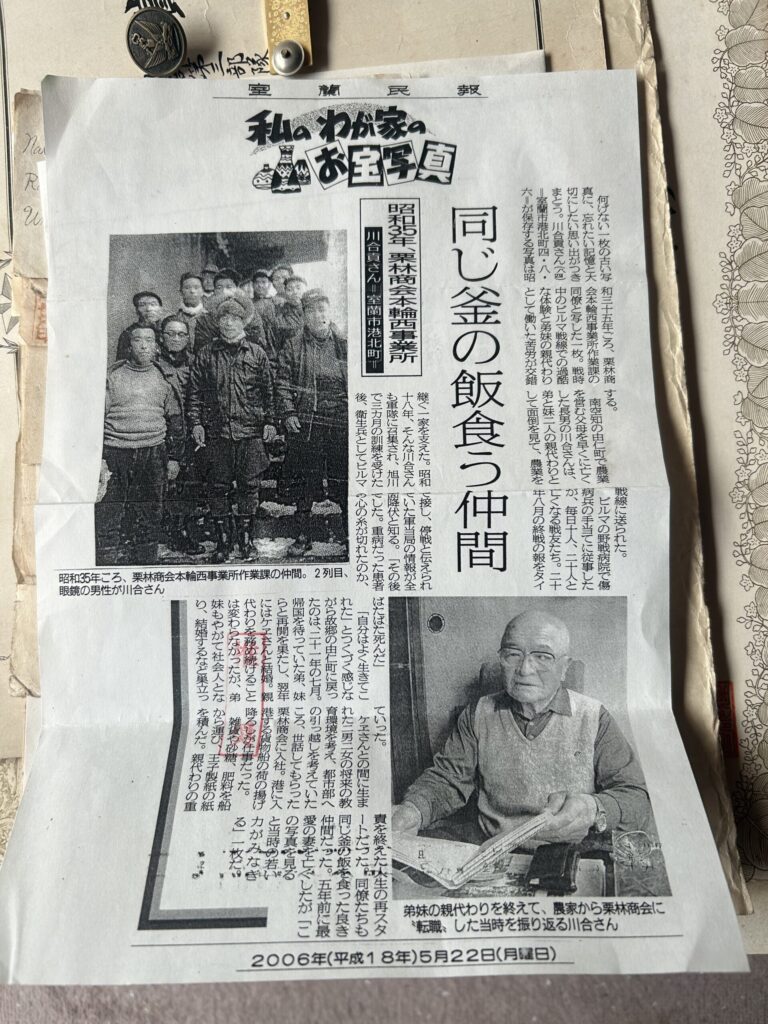
2006年の室蘭民報という公的なメディアですでに実名で報道されていること、および本人が文集という形で「記録を後世に残す」意志を明確にしていたことから、歴史的人物として扱い、故人の遺族の許可を経て文章を公開しています。
ビルマの想い出
川合 貢
【出陣とビルマへの道】
昭和十八年六月アッツ島山崎部隊玉砕後、第七師団第一野兵病院の編成が解かれて、三箇月間の衛生兵教育を受け、林一三六五部隊の認識票を膚(はだ)につけ旭川陸軍病院を出発したのが年の瀬の十二月二十二日早朝で、杉本中尉以下八十八名の補充交替要員が護國神社に参拝、武運長久を祈願して雪の旭川と別れを告げ乗船地の門司へ向った。
昭和十九年一月三日門司港を二十四隻の輸送船団で出航、途中高雄港とマニラ湾に寄港し、マニラで船団を編成替えしボルネオ島沖で単独航海となり、シンガポールへ上陸したのが一月二十五日でした。ここに約一ヵ月滞在しゴム林続きのマレー半島を列車で北上、タイ国チュンポンから徒歩およびトラック便でビルマ領モールメンに着く。同地の宿で夜半に敵機の機銃掃射を受け、ここで初めて戦地だという感じを持った。マルタバンへ渡河する、サルウィン河上の大発船上では敵機の来襲を恐れながらの四十分間位だった。ペグーから貨物列車で一路マンダレーに向いましたが、途中たびたび敵偵察機の来襲がありその都度列車から離れて待避したものでした。
だが幸いに誰一人事故も無く全員無事にマンダレーに到着したのが、インパール作戦最中の三月半ば頃の早朝だったと思います。先ず驚いたのは立派な金のパゴダと暑いことでした。その夜直にメイミョウの本隊へ夜行列車で出発、当時世界一と言われたゴテクの大鉄橋を渡り、待望のメイミョウに到着し、病院本部前で藤原病院長殿に本隊追急の申告が終わったのが、旭川を出発してから約四ヵ月振りのことでした。
ここまでの行動期間中私にとっては珍しい南方の果実、バナナ、パパイヤ、ドリアン、マンゴ、マンゴスチン、ザボン等いろいろ食べましたが、マレー半島のドリアンとパインの美味かったあの味は今でも忘れることが出来ません。喉の渇いた時の椰子の実の水の味もまた格別でした。メイミョウではジャワ派遣と言われて先発していた江連、本田、浜野、大山、村井君等がここに勤務していて、十八年九月に旭川で別れて以来の再会で非常に嬉しかった。十日間位の体養中に補充交替の要員の勤務先も決まり、私はラジオ分院庶務室勤務が発令され、三月末頃に村上君等数名と共にラジオへ赴任したように記憶している。当時のラジオ分院は土橋分院長以下衛生勤務員は五十五名だったと思う。
【メイミョウでの爆撃とジャングル病院】
ラジオ勤務になって私の最初の仕事はメイミョウ本院への列車による約二百名位の患者護送だった。月日は忘れたがこの日の朝駅附近で乗車の待機中、コンソリデデットB24、四十二機位の大編隊の空襲があり、ラジオ市街は水平爆撃で全壊した。病院だけは幸いに難を免れ犠牲者は一人も出ず、私もラジオ駅附近にいたため市街へ落下する爆弾の黒い数多いのと、爆発音の物凄さをまざまざと見せつけられただけで、爆撃の恐怖には会いませんでした。
この患者後送出張から帰着してから、進攻作戦当時から開設していた、夜香樹の大木のある思い出多いラジオ病院本部事務所をラジオ連絡所として残し、これより北方一哩(マイル)及四哩地点にジャングル病院を開設しましたが、この頃からインパールも雲南作戦も旗色が悪くなり、雨期に入った五、六月から敵機の来襲は日増に激しくなり一番多い日は延べ二百機のひもありました。
来襲の都度分院本部前の木の枝にブラ下げたホイルを叩いて、空襲警報の合図をして防空壕に逃げ込む毎日でした。私は庶務室兼外科重症病棟の勤務でしたのでニッ谷さん、片岡さん方には特に患者の治療看護の御指導を頂いたものです。雲南作戦の「ら孟と騰越(とうえつ)」で五十六師団の第一野戦病院が玉砕してから、前線から、夜間トラックで後送されて来る負傷患者が急増して七、八月頃の収容患者は千二、三百名に達したと思いますが、病棟が不足になり分院から北へ一哩の五哩地点へ軽症患者の病棟を二棟増築して急場を凌いだわけです。
この頃から昭和二十年二月のタイへの転進までの間は伝染、外科、内科病棟を含めて死亡患者は一日平均十名乃至十二名くらいだったでしょうか。発着部の井上さんにお経を上げてもらって死亡された患者さんの肘関節を外して、鉄板にのせて火葬にし、間違いないように遺骨を骨函に入れたものですが、あとの遺体は火葬する傍の凹地に積み重ねるようにして一mから一・五mの土をかけて埋葬しましたが、この埋葬場を荒しに飛来する禿鷹(はげたか)と野犬には全く閉口しました。あの頃から三十年近くも経った現在、異国のあの地に眠る遺体はどんなに成っていることでしょう。出来ることならわれわれの手で残りの遺骨を収集して慰霊碑でも建立して上げたいと思います。
【敗走とマラリア】
このジャングル病院も、昭和二十年二月十一日にシポー街道三一三地点附近に敵迫撃砲の砲撃を受けその夜司令部後退もあり、二十二日からはタイ国へ向っての患者後送が、私の思いではビルマ滞在中の、生か死かの一番苦しかった行程だったと思っています。ライカでは本院も分院も赤松林の奥に合流して、病院を開設しながらその後の転進のための行動隊編成をしたと記憶しております。ここで私は黄疸に罹りましたが一週間で全快し、同郷由仁出身の益本藤吉さんと四年振りで再会して一別以来の故郷の後のことを語り合ったものでした。
ライカの期間もどのくらいだったか失念しましたが、私は何時も残務整理の方を命ぜられました。被服倉庫にガソリンをかけて火をつけ燃え終わってから、ロイコウへ、モスキート機の街道荒しに悩まされながら、第一線部隊の竜兵団(第五十六師団)が通った後二日遅れての行動はほんとに心細かったです。
ロイコウを経てサルウィン河の渡河地点ケマピュへ着いたのは六月下旬頃で、雨期のため毎日一反くらいずつ水嵩(みずかさ)の増す河岸の宿舎で大発船の迎えに来るのを待ったわけですが、最後の渡河部隊のため野菜不足には大変困りました。附近にあるバナナの木を切倒して中芯の柔い所を薄切りにし食塩をふりかけてその汁を吸って漬物代わりにしました。近い所にカチン族の部落がありましたので、皆で野草を探しに行きましたがヨード欠乏症で大きなコブが首に出たカチン族に恐れをなして手ぶらで帰って来た思い出等があります。
われわれ酒井少佐以下数十名が軍通信部の方を含めて百名くらいだったでしょうか、渡河用の大発船が迎えに来てくれたのは七月一日の午後の三時頃ではなかったかと思います。水勢強い急流を約一時間近くかかって対岸へ無事に着く。(急流の中頃で牛一頭船より転落し一瞬にして押し流されて水没したハプニングあり)この夜はちょうど月食で夜道は暗く、ブヨのような小さな虫にイライラさせられながら四十二哩(マイル)の泰緬(タイビルマ)国境へ向ったのでありますが、二泊三日の行程でしたが七月二日より私は四十度を上下するマラリアに罹りましたが、皆と共に四十二哩地点の中継所まで漸く到着することが出来ました。ここで脚気症状となり玄米を火で焙り玄米茶を飲みながら一週間くらい休養して、体力回復に努力したことを記憶している。四十二哩では国境越えのための患者療養所が開設されていたが、重症患者はここから象の背に乗せられて国境を越えてタイ国へ入ったわけです。
【終戦と帰還】
ここからタイ側の友軍の遠藤政後さんが急逝された、命日はたしか七月十日でした。彼を埋葬して合掌したあの日のことを今でもありありと思い出されます。そして私は遠藤さんの遺骨と遺品を庶務の柴田雅義さんから預り背負って、山下勇さんと二人で国境越えしたのが忘れない七月十二日で、象が先に歩いたあと足跡を追いつつ三一地点の第一中継所まで、お互いに疲れて強心剤を注射し合って足を滑らせながら夕暮時に着いたものでした。ライカで別れ先発していた益本さんとここでまた再会した。
ここから下り坂の河床道路の七十地点を過ぎ二十五哩のクンニャムまでは割り合いに楽な道程で、途中青いレモンの実にも恵まれて、私の体力も次第に回復しクンニャムの本隊へ追急した時は大体元気になっておりました。
クンニャムの寺院の宿舎で八月十五日の正午頃、天皇陛下の重大放送があるとの軍通信の方から通報を受けましたが、日本国無条件降伏のポツダム宣言受諾の壁新聞が街頭に貼り出されるまでは、よもや敗戦終戦とは信じられないことでした。この壁新聞の貼り出しは二十日のことでした。クンニャムに何日位滞在したか忘れましたが、ここからバンコクへ出るまでの山また山の道程が一番苦しんだ道中であり、私達の戦友が一番転没されたと思います。
一日一生懸命歩いて三、四百mしか前へ進めなかった日もありました。十分間歩いて一時間も休憩し、一日水筒一本の湯ざまし水と米に余分な物を持てない、生きるためのぎりぎりの限界線であの道中を良ぞ生き抜いて来られたものだとつくづく思います。
ここで非常に残念なことは、クンニャムからバンコクまで一緒に行動を共にしたと思われる数十人の方の名前をどうしても思い出せないことです。桜庭六七生さんとは一緒だったと思うのですがどうでしょうか……。今ビルマ、タイの地図を開いてあのアゴ峠とか白骨峠といわれた附近の山脈は千mから二千mの高さの色で表されているのですが、唯一心に日本内地へ無事に帰り着きたい精神力だけで歩き通したのだと言っても過言ではないと思います。漸くにしてバンカツに辿り着き、アヒルの肉の水炊と卵とじ等で道中の疲れを癒し、チェンマイに集結最後の病院業務を終了後、列車で南下してナコンナヨークに集結完了、バンコックまで迎えに来てくれた日本貨物船の日の丸の旗を見た時は感激しました。
昭和二十一年六月二十二日出港、連日の台風の中を無事に六月二十五日浦賀に入港、夢にまで見た母国の土を踏んだのが三十日の朝でした。九里浜の宿舎の畳の上に落ち着いた時はホッとしたものでした。ここで復員手続きをし復員局へ戦友の遺骨を納め終わってから満員電車で上野駅へ出たのが、七月十日朝でした。思えば十九年一月から二十一年六月までの体験は私の生涯の中で最も尊いものだった。今ここにビルマで御世話になりました戦友の諸兄に心から有難う御座居ましたとお礼を申し上げます。
歩み来しビルマの道は峻しくもわが生涯に悔ゆることなし
◎今は亡く深山(みやま)に眠るわが友の
朽ち果てるとも御霊(みたま)やすかれ
昭和四十七年三月二十日(春分の日)記
北力会 20周年記念 昭和48年8月6日 於札幌
「消失の淵より救いし魂の記録 ―― 川合貢氏と167名の戦友たちへ捧ぐ」
「本資料の公開にあたって」
「本資料は、故・川合貢氏が死の間際まで大切に保管し、後世への伝承を願った貴重な歴史的遺産です。公開にあたっては、現在のご遺族のプライバシーに配慮し、一部の個人名や詳細な住所等を伏せております。これは、故人の遺志である『歴史の真実を伝える』ことと、現代の倫理を両立させるための措置です。」
[English Translation for Official Website]
Memoirs of the Burma Warfront: Weaving the Legacies of the Fallen
Foreword
This record is treated as a significant historical archive. The author, Mr. Mitsugu Kawai, was officially featured in a public media report by the Muroran Minpo in 2006. Furthermore, he explicitly expressed his intent to “preserve these records for future generations” through this memoir. In accordance with his final wishes, we present this as a testament to an individual’s lived history.
Memories of Burma
By Mitsugu Kawai
I. The Outset: The Path to Burma
Following the annihilation of the Yamasaki Force on Attu Island in June 1943, the 1st Field Hospital of the 7th Division was disbanded. After three months of medical training, I was assigned to the Hayashi 1365 Unit. Carrying my identification tag close to my skin, I departed the Asahikawa Army Hospital in the early dawn of December 22, amidst the winter snow. After praying for long-lasting fortunes of war at the Gokoku Shrine, we bade farewell to a snow-covered Asahikawa and headed for Moji, our point of embarkation.
On January 3, 1944, we set sail from Moji Port in a convoy of twenty-four transport ships. After calling at Kaohsiung and Manila, the convoy was reorganized, and we sailed solo off the coast of Borneo before landing in Singapore on January 25. Following a month-long stay, we traveled north by train through the rubber plantations of the Malay Peninsula. From Chumphon, Thailand, we proceeded on foot and by truck to Moulmein, Burma. It was at our inn there, during a midnight strafing run by enemy aircraft, that I truly felt I had entered a war zone. Crossing the Salween River to Martaban aboard a large landing craft was a harrowing forty minutes, fraught with the fear of aerial attack. From Pegu, we headed toward Mandalay by freight train, frequently leaping from the cars to seek cover during enemy reconnaissance runs.
Fortunately, we reached Mandalay without casualty in mid-March, just as the Imphal Campaign reached its height. I was first struck by the sight of the magnificent golden pagodas and the stifling heat. That very night, we departed for the main unit in Maymyo by night train. Crossing the Goteik Viaduct—then said to be the highest in the world—we finally reached Maymyo. It had been four months since our departure from Asahikawa when I finally reported for duty to Hospital Director Dr. Fujiwara.
During this journey, I tasted many exotic southern fruits: bananas, papayas, durians, mangoes, mangosteens, and pomelos. I shall never forget the exquisite flavor of those durians and pineapples on the Malay Peninsula. The milk from a fresh coconut when parched with thirst was also beyond compare. In Maymyo, I was overjoyed to reunite with comrades like Ezure, Honda, Hamano, Oyama, and Murai, who had been dispatched earlier and from whom I had been separated since September 1943. At the end of March, I was assigned to the administrative office of the Radio Branch Hospital, where I served under Branch Director Tsuchibashi in a staff of fifty-five medical personnel.
II. The Bombing of Maymyo and the Jungle Hospital
My first duty at the Radio Branch was to escort approximately two hundred patients to the Maymyo Main Hospital by train. While waiting to board near the station, a massive formation of about forty-two Consolidated B-24 bombers launched a horizontal bombing raid. The town of Maymyo was completely leveled. Miraculously, the hospital was spared, and we suffered no casualties. I watched from near the station as countless black bombs rained down on the town; the sheer violence of the explosions remains seared into my memory, though I personally escaped the terror of the blast.
Following my return from patient escort duty, we established “Jungle Hospitals” one and four miles north of Maymyo, leaving the original administrative office as a liaison post. As the tides of the Imphal and Yunnan campaigns turned against us, enemy air raids intensified from May and June onwards, with up to two hundred aircraft appearing on the heaviest days.
Whenever a raid began, someone would strike a suspended wheel-rim as a siren, and we would dive into air raids shelters. Serving in the administrative office and the surgical ward for the severely wounded, I received guidance in patient care from seniors like Mr. Nitani and Mr. Kataoka. After the annihilation of the 1st Field Hospital of the 56th Division during the Yunnan Campaign, the influx of wounded transported by night trucks from the front lines surged. By August, the number of patients reached 1,200 to 1,300, necessitating the construction of additional wards for those with lighter injuries.
From this period until our retreat to Thailand in February 1945, the death toll—across the infectious, surgical, and internal medicine wards—averaged ten to twelve patients every single day. Mr. Inoue from the dispatch department would chant sutras as we performed cremations. We would remove the elbow joints of the deceased to place them on iron plates for cremation, ensuring the remains were placed in urns without error. However, the rest of the remains had to be buried in pits near the cremation site, covered with about one to one-and-a-half meters of soil. We were utterly distressed by the vultures and wild dogs that came to desecrate these burial grounds. Now, nearly thirty years later, I wonder what has become of those remains left in that foreign soil. If it were possible, I wish to collect what remains and erect a cenotaph to their memory.
III. The Retreat and Malaria
On February 11, 1945, this Jungle Hospital also came under enemy mortar fire near the 313-point of the Hsipaw Road. Following the headquarters’ retreat, we began transporting patients toward Thailand on the 22nd. This was, in my memory, the most agonizing journey of my life—a literal struggle between life and death. At Raika, the main and branch hospitals merged in a pine forest to reorganize for the further retreat. There, I contracted jaundice but recovered in a week. It was here I reunited with Mr. Tokichi Masumoto, a fellow native of Yuni, for the first time in four years, and we spoke of home.
I cannot recall exactly how long we remained at Raika, as I was perpetually assigned to the cleanup of abandoned supplies. After setting fire to the clothing warehouse with gasoline, I moved toward Loikaw. The trek, plagued by “Mosquito” ground-attack planes and occurring two days behind the main Dragon Division (56th Division), was profoundly lonely and frightening.
We reached Kemapyu on the Salween River in late June. While waiting for landing crafts amidst the rising monsoon waters, we suffered a severe lack of vegetables. We resorted to felling banana trees, slicing the soft inner core thinly, and salivating over the juice seasoned with salt as a substitute for pickles. There was a Kachin village nearby, but we were intimidated and fled upon seeing villagers with large goiters caused by iodine deficiency.
In early July, about a hundred of us, including Major Sakai and members of the Signal Corps, finally boarded landing crafts. It took an hour to cross the powerful, surging current; at one point, an ox fell overboard and was instantly swept away. That night, under a lunar eclipse and in pitch darkness, we were tormented by tiny biting gnats as we headed for the Thai-Burma border. During this forty-two-mile trek, I was struck by malaria, with a fever fluctuating around 40 degrees Celsius (104°F). Through sheer willpower, I reached the transit post. Suffering from beriberi, I spent a week roasting brown rice to make tea, struggling to regain enough strength to survive.
IV. The End of War and the Homecoming
On July 10, a comrade from the Thai side, Mr. Masago Endo, passed away suddenly. I still vividly remember offering a prayer as we buried him. I carried his remains and personal effects, entrusted to me by Mr. Masayoshi Shibata, and crossed the border with Mr. Isamu Yamashita on July 12. We followed the footprints of elephants, helping each other by injecting stimulants when exhausted, eventually reaching the first transit post at dusk.
The path from the 70-point of the river road past the 25-mile point to Khun Yuam was relatively easy. Blessed with green lemons along the way, my strength gradually returned. On August 15, at our quarters in a temple in Khun Yuam, we were notified by the Signal Corps of a significant broadcast by the Emperor. However, until the wall posters announcing Japan’s unconditional surrender and acceptance of the Potsdam Declaration appeared on the 20th, we could not believe we had lost the war. The trek from Khun Yuam to Bangkok was the most grueling part of the journey; it was here, I believe, that most of our comrades fell.
There were days when we could only advance three or four hundred meters despite a whole day’s effort. We would walk for ten minutes and rest for an hour. Surviving on a single canteen of water and a meager ration of rice, unable to carry anything extra—I often wonder how we survived that journey at the very limit of human existence.
My greatest regret is that I cannot remember the names of the dozens of comrades I traveled with from Khun Yuam to Bangkok. I believe Mr. Rokushichi Sakuraba was among them. Looking at a map of Burma and Thailand now, those mountain ranges near the “Ago Pass” or “White Bone Pass” are shaded for heights of 1,000 to 2,000 meters. I do not think it an exaggeration to say we walked through them solely on the spiritual strength of wanting to return home alive. Finally, we reached Bang Khat, where we recovered our strength with boiled duck and eggs. After completing our final hospital duties in Chiang Mai, we traveled south by train to Nakhon Nayok. When I finally saw the Hinomaru (the Japanese flag) flying on the Japanese cargo ship that came to meet us in Bangkok, I was overwhelmed with emotion.
We set sail on June 22, 1946. Despite a continuous typhoon, we safely entered Uraga Port on June 25. On the morning of the 30th, I finally stepped onto the soil of my motherland—a moment I had seen only in my dreams. Resting on the tatami mats of the barracks in Kurihama, I felt a profound sense of relief. After completing repatriation procedures and handing over the remains of my comrades to the Repatriation Bureau, I boarded a crowded train and arrived at Ueno Station on the morning of July 10. Looking back, my experiences from January 1944 to June 1946 were the most precious of my life. To my brothers-in-arms who looked after me in Burma, I offer my heartfelt gratitude.
The path through Burma I walked was steep and rugged,
Yet in my life, I have no regrets.
◎ To my friends who now sleep in the deep mountains,
Though your remains may crumble into the earth, may your spirits find eternal peace.
Recorded on the Vernal Equinox, March 20, 1972.
Hokuka-kai 20th Anniversary Commemoration
August 6, 1973, Sapporo.
Dedication
“To the Records of Souls Rescued from the Brink of Vanishing — Dedicated to Mr. Mitsugu Kawai and his 167 Comrades.”
Statement Regarding the Publication of these Archives
These materials are precious historical legacies, meticulously preserved until his final days by the late Mr. Mitsugu Kawai, who wished for them to be passed down to future generations. In publishing these records, we have taken care to protect the privacy of surviving descendants by redacting certain personal names and detailed addresses. This measure is intended to reconcile the deceased’s wish to “reveal the truth of history” with modern ethical standards for privacy.
Curated and Rescued by Keiji Tazawa
CEO, LRA association
Practitioner